Thursday, 23 April 2020

A year in the life of a pond

Reception pond

When the new reception hide and facilities were built in 2016 the pond, that is now referred to as the reception pond, was created. It was excavated in a clearing created from the removal of windblown larch and the resulting clay topsoil was used to form the access ramp to the reception hide. The pond is up to 2m in places and is mostly self-lined by natural clay but there are pockets of peat around the edges, so some areas had to be bunded by conventional pond liner and puddles clay. It was left to fill naturally, which continues, from rainwater and the roof run off from the reception hide, acting as an ‘aqua green’ to contain any excess water before it is released into the surrounding ditches. When there was only 30cm of water the first inhabitants were recorded; great diving beetle, several species of dragonfly, midge larvae and the ‘endearing’ marsh frog. Since then the aquatic wildlife has been left to colonise.


When schools visit, they have several activities that they can choose to take part in and one of those is pond dipping. This gives the children a great opportunity to do some very valuable scientific sampling. They learn how to use the simple equipment safely and correctly to sample the water from the dipping platform. They then use identification keys (FSC charts) to name all the organisms that they catch, which they then record. The identification key is not detailed to species level for many of the invertebrates, but it is an appropriate tool for primary age pupils to use as they rarely have undertaken pond sampling before, so most organisms are new to them. Once back in the classroom we record everything centrally giving an indication of species diversity and abundance. The counts are not accurate full counts, they are recorded as present or absent across the ten working groups, eg a score of 1 is given if only one group found that species, regardless of how many they actually caught. Since its creation the pond has only been sampled by visiting school children, so their role is key in recording the changing biodiversity of the pond and in so doing values the importance of their work as visiting scientists on the reserve.


For last year, 2019, I have collected all the data and it provides an interesting picture of how the pond changes over the year, starting in April right through to November. In that time 25 species have been found; 23 invertebrates, 1 fish and 1 amphibian. The most common species throughout the year, seen in every class sample, are lesser water boatmen, ramshorn snails, stickleback and damselfly larvae. Some species; burrowing mayfly nymph, stonefly and hairworm have only been recorded once over the year. Certain species are found at certain times; marsh frog tadpoles are not seen until early July as would be expected, whereas damselfly larvae numbers peak in the autumn, suggesting that these individuals are overwintering in the pond, contrasting to dragonfly larvae which are seen in abundance in June but are not recorded in October and November. Stickleback numbers reach a peak in June and July, but the data does not specify whether these have been adults or fry. The number of pond skaters drop from the end of July and are not recorded in autumn. Ramshorn snails and lesser waterboatmen as well as being recorded in every class sample during the year are also the most abundant throughout the year, being seen by large numbers of the groups in the class; in July all groups in the class caught lesser waterboatmen.


From these records the pupils can see the biodiversity of life in the pond and appreciate that some species are more common than others. Their favourites have to be the sticklebacks and the marsh frog tadpoles, maybe because these are species they are more familiar with. Research shows that children are able to learn and retain specific species names and so introducing them to burrowing mayfly nymphs and hairworms is beneficial to their subsequent recall of a pond habitat and its feeding relationships. Highlighting the tremendous jaws of a dragonfly larvae or the pincers of a pond stick insect engage pupils with an unfamiliar but equally fascinating pond organism, widening their knowledge and understanding of the pond as a habitat, adding value to the simple activity of pond dipping.


Monday, 20 April 2020

Watchful eyes

Hopefully everyone is managing to get some great wildlife from home;  One of our volunteers managed a nice little ringed plover locally on a daily excercise walk:
And Brian our camera guru has his own home network so he can watch the blue tits in a nest lined of his own hair after being DIY pruned in the middle of the lawn...


We've purposefully not been posting information from Tophill Low on sightings as we feel it unfair to tantalise our regulars (and indeed incite people to visit).  We will be adding some trail camera footage now and again but not giving a running commentary.  Once some breeding species are firmly established we may put an update on later.  Suffice to say all is well - a few scenery shots to show it still exists:

The main point we would like to get across is that whilst Tophill Low Nature Reserve is closed to the public; It is still staffed with site monitoring being undertaken every day

Whilst getting to see the wildlife is undoubtedly a perk we have a rota of checks to ensure that environmental permitting is upheld, sluices and water controls are working and not blocked or flooded, livestock checked, and our safety and security responsibilities as a landowner upheld.  Tophill Low's main purpose is a drinking water supply and as key workers we do not want our process engineers needlessly placed in contact with members of the public that shouldn't be on site.  In addition we also have constant updates from residents at Tophill Low keeping a watchful eye and reporting all incursions - suddenly having to drive 3 miles to the nearest village for years has come into its own and they would undoubtly like to keep it that way.  We also have the usual CCTV and various trail cameras monitoring all corners of the site. 

So all incidents like the couple in a vehicle attempting to drive in off the river bank today (illegal without Environment Agency permission), or these two trespassing and illegally fishing on Watton Nature Reserve on Friday (and potentially disturbing schedule one species) have been reported to Humberside Police. 

Whilst it may seem a good place to isolate and exercise 'away from people' please respect the site and its wildlife and particularly those whom live and key work at Tophill Low and stay away.  As many have observed this is a once in a lifetime event for wildlife also - and even if not this season we expect some of the increases in species and nesting on site will return for next year if everyone is sensible and is something positive to look forward to out of this. 

Wednesday, 1 April 2020

Wildlife on your doorstep

April 1st 2020

Due to the current circumstances I, like all the staff and volunteers, am missing being a part of the incredible team at Tophill Low. It's been a few months since a school group has visited the reserve as the last group visit was at the end of November. Meanwhile, I have been in local schools working with pupils learning about all things to do with water and in particular the problems of flooding in Hull. Ironic when you consider the situation at Tophill back in January. So learning has been taking place; whether it's inside the classroom or out on the reserve working alongside children who are so enthusiastic about everything new that you can teach them, is a great buzz.

Now, for everyone, it's completely different and I've been producing, along with my colleagues, some on line resources for Yorkshire Water's education web pages to get pupils learning at home. There are activities on the site about cleaning water, poo power, saving water, the water cycle and also learning about the environment outdoors. Please visit Education resources to access a wealth of information you can use with your children at home.


One pond in my garden is made from an old sink


Purple violets are now flowering and attracting insects


And I have been learning at home too. By taking the time at home that we all have a little more of, I've been spending much more time observing the birds and wildlife just outside my door. My garden is obviously not on the scale of Tophill Low but if you plan and manage your garden in a wildlife friendly way then you can create your very own nature reserve. I have a couple of ponds where about a month ago we saw mating common frogs, there is a log pile harbouring woodlice, millipedes and spiders, flowering purple violets attracting early emerging bees and a clump of ornamental grass which I know has been used by a hedgehog over winter. Even spending time weeding my flower beds I have discovered a type of bee fly and there's been plenty of ladybirds. But with all these animals I know the family but not quite the species so I've been trying to learn them which has been quite a daunting task on occasion but fascinating too. There's always something to learn about the wildlife around you.

Even in fields where you might think you have a good knowledge of species, in my case birds, there is always something to learn. Common garden birds make an ideal subject in the present circumstances and by spending more time watching I'm finding out more about some of the common visitors to my garden. Feeding hierarchy at the bird table and feeders is very prevalent with a pack of long tailed tits only ever visiting early in the morning. Coal tits very rarely stay long on the feeders, quickly taking their seed and flying off, whereas blue tits and great tits spend much longer with great tits preferring to use the perches on the seed feeder, the blue tit clinging onto the wire on the fat balls. The size difference in coal tit and great tit is very noticeable if they arrive together but looking at these two species the plumage pattern on the face is very similar. Top of the pecking order in my garden are a very healthy colony of tree sparrows who seem to nest everywhere, from the dedicated line of boxes we've put up to behind a wall bracket for a flower basket. There is so much more to learn and I am looking forward to taking the opportunity of doing so.

Coal tit and great tit showing their very similar face plumage

Yesterday I took part in a challenge that gave a bit of competition to my garden birding and that was to join virtual teams across the globe in their own bird races to support the Champions of the Flyway project that runs every year in Israel to highlight and fund raise for projects linked to the plight of migrating birds. Every time I went out in the garden or looked out of the window I recorded the species that I saw, whether they were feeding in the garden, flying over or I could see them in the fields that adjoin our property. By the time night fell I had recorded 37 species and my husband had also seen a red legged partridge from his office, so 38 in total. Although there had been some omissions like the great spotted woodpecker that normally visits every day and the barn owl that hunts across the fields that I can usually see at dusk from the house, I was pleased with the total and especially delighted to find a pair of prospecting pied wagtails around some ivy in the garden and a roosting little owl in the field hedge. 


Pied wagtail on the lawn

There are plenty of images, challenges, videos, quizzes, reports and fantastic photos to enthuse and inspire you on a variety of social media platforms as well as all those books on our shelves that we haven't dipped into for a long time. So if you can, seize this strange opportunity that we have to stay at home and really enjoy the wildlife that we have on our own doorsteps.


Monday, 30 March 2020

Catching up

Hopefully if you've not done so then being incarcerated inside on the current cold days is a great opportunity to catch up on some of the old reports and familiarise yourself with what to see when we do finally get back; The link is on the reports tab above.  

Regretfully with everything else going on over the last few years we haven't delivered any recent annual reports but a number of the Tophill team have been beavering away over several months to play catch up and deliver a comprehensive 2014-18 annual report.  My huge thanks to all involved in a massive amount of work.  

The original plan had been to make this a perk of the new membership season and inspire everyone,  but given the present circumstances and that we're unlikely to be back into this for sometime we've decided to make it freely available here as a download.  Hopefully it will give everyone something to look forward to later in the season.  It is possible that we may do a printed version at some stage but 'physical contact' seems a bit Passé these days.

A brilliant reflection on the reserve and its wildlife its a credit both to the writers and all the volunteers that help conserve the amazing wildlife.  

Wednesday, 25 March 2020

Trail Cameras To The Rescue!

This week has brought some big changes, further restrictions on movement, countries closing their borders and countless businesses closing their doors to the public all in an effort to stem the rapid spread of COVID-19. Following government advice Yorkshire Water's policy on visiting recreational sites too has changed:


Yorkshire Water encourages everyone to stay home to help battle coronavirus 
 
On Monday (23rd March 2020) Yorkshire Water – in line with water companies across the UK – is closing down its reservoir car parks to help encourage everyone to stay at home.


Over the weekend, there were unprecedented numbers of visitors at Yorkshire Water’s reservoirs and concerns were raised about everyone’s ability to follow social distancing guidelines under such busy circumstances. Yorkshire Water took the step to close the car parks and will be installing temporary signs and barriers to encourage visitors to stay away.

 Gaynor Craigie, Land and Property Manager said: “We’ve all got to play our part in keeping everyone safe. We’d normally be thrilled to welcome so many visitors to our reservoirs, but with the current government guidelines it makes it incredibly difficult to keep everyone safe.

 “We know it’s important to get some fresh air and exercise, particularly at the moment, but it becomes a risky activity when everyone ventures to honey pot sites. Our reservoirs will still be there for everyone to enjoy when the restrictions have been lifted.”
------------------------------------------------------------------------------------------


Whilst we are all in the same boat, locked away from the glorious bright sunshine outdoors we thought it would be the perfect time to share some of the happenings that we've managed to catch on our trail cameras this winter.

A beautiful frosty morning this February when the reserve was shut to
support the riverbank repairs undertaken by the EA and BAM

Since arriving at Tophill Low back in September, like all of our visitors and members I have enjoyed spending many hours walking through admiring the surroundings and the wildlife that is within. In the first few weeks of starting at the reserve a long-term member told me something that has stayed with me, he said "you get to do something for a living that the rest of us have to pay for to do". I have found this to be so true, in many aspects of this role... Not all of them though.


Undoubtedly, the biggest downside and drawback of working at Tophill Low is that you don't actually get to sit in the hides all day taking pictures of both the incredible wildlife and beautiful scenery. Who knew?! Between the emails, texts and phone calls in the office, the ticket machine chewing up new shiny plastic fivers and trying to find the amazingly well camouflaged Belted Galloways there are plenty of other jobs to be getting on with. At first, I think I could get away with it a little easier... "So, where is the Angus McBean hide again?" and "Can we go and look at the changes you've made on South Marsh East again..." doesn't fly after 6 months on the job.

To get my wildlife fix I rely on the marvellous trail camera collection we have at Tophill Low. I admit, initially I was most excited to play with a new gadget and the idea of capturing some intimate footage of local wildlife was second to that. However, I quickly found that once you have set the camera up, trigger it and walk away the excitement of that new, shiny gadget wears off with immediate effect. It then evolves into something far more compelling...


Our most advanced trail camera. In the future we aim to invest in trail cameras
with displays screens to ensure more quality footage and less reed bed footage.
An almighty war of attrition between impatience and patience ensues. I've found half of the battle is wondering if you've set the camera at the best angle. Is it worth going back to pull the camera out to go over the footage and check to only have to reposition it?! Or do you leave it and gamble, just hoping against hope that it's all going to be ok? Once I've finally made my mind up on that factor the next battle begins... How long is long enough? Should I leave it there a few days? A week? Two? (I'm not even going to pretend to convince you all that I have the patience to leave it for a month) And then finally, one last mental battle, and perhaps the hardest...  Once I've collected the footage should I now move the camera to a new location completely?

I've had some big wins just changing the direction the camera is facing. After spending many hours watching footage of reeds gently swaying in the middle of the night, I decided that whatever it was that was triggering the camera must have been moving passed too quickly to be caught. I gambled and turned the camera to face the other way. One of the first clips on the SD card was a family of 3 otters running through the shot - albeit their rear ends!


It always plays on my mind that I should try to 'leave it longer' or I shouldn't 'relocate it so soon' or should I just 'change the direction'. More often than not I can make peace with all this by reviewing what I have captured. Over the last 6 months I've found that by moving the cameras around frequently and checking back on them more often I've been able generate a variety of footage and images. Some of the best clips and stills I have managed to edit into something a little more presentable so we can share them with you all. Over the coming weeks we will keep releasing new clips so you can see what exciting things have been occuring while we've been shut. And we'll finally get to the bottom of this...

The video that follows is just a short time lapse of a hole I found in a tree stump one afternoon while conducting a site inspection following Storm Ciara. I don't really know what I was expecting to capture, perhaps a single curious little Blue Tit... Who knew it would get such attention?

Sit back, enjoy and just remember... "Good things come to though who wait".


Thursday, 19 March 2020

Jurassic Low

Some bad news I'm afraid, Tophill Low will remain closed for the foreseeable future.  It's truly been a crazy year both at Tophill and in the wider world. 


Perhaps the flooding was a blessing for us in terms that we have been used to the shut down for several months and it's merely a continuation, so strangely the current crisis in our world is but another eye roll.  Much like the flooding the situation as for everyone has been changing daily and we've been trying to react to that so my apologies I haven't been able to update in the interim;  To guide you through our thought process in coming to this decision;


Tree damage - whilst some of the work has been rectified much is yet to be touched.  Even last week we found a tree creating a magic carpet as it's root plate lifted up and down just yards from the reception hide.  Our contractors racing to clear up damage across the region and facing their own staff challenges have yet to be able to rectify the many issues around site. 


Operational works - the Water Treatment Works are currently undertaking clearance work at the lagoon sluices to meet water quality standards and catch up from the flooding shut down.  This work could damage or compromise the boardwalks and paths in that area. 


Staffing - most of our reserve staff and volunteers have self isolated as some have experienced symptoms or are in vulnerable groups.  We are unsure of our ability to monitor or react to any hazards raised in opening the site or in the work above.  The reserve is not a simple site it has many structures, hides, bridges etc and we need to ensure they are in a safe order.  Much has not yet been inspected since the flood closure as we have been fighting to complete essential habitat work for breeding season and not looked at 'human stuff.' 


Buildings - we knew from the off that we would have to close the reception hide (all School visits were suspended last week for the foreseeable future), toilets and wardens base.   With no facilities we do have to think of our residential neighbours and water quality. 


Hides - of much debate we have come to the conclusion that we can't open them.   Some like the Izzard and North Marsh hide would be undoubted clusters and against all government advice.  Closing individual ones just moves the pressure elsewhere.  We considered leaving the hides locked.  However we know people would then just look around the edges or over walls - again in clusters most often.  We then need to factor in the wildlife - we know we have scheduled species interested in the site and we can't risk disturbing these or the SSSI's.   Excitingly the site is really wild and nature has reclaimed it.  As Warden, especially as a marsh harrier passed low above me whilst adjusting the sluices last night, I don't feel it right for the wildlife to have to go from zero disturbance for 4 months to people crashing around trying to see through undergrowth and around hides causing more disturbance than normal operation.  I'm sure all our Tophill regulars would agree that the wildlife comes first above our curiosity.  I'm also minded that many of our regulars at Tophill Low are self-isolated as they are in the 70+ age category or vulnerable.  Is it fair that a minority have free reign to potentially cause havoc on a semi-open site whilst the majority can't enjoy it?


General shut down  - We have all seen what's happened in southern Europe.  It seems inappropriate to be taking down closure notices and re-opening etc when realistically we know what's coming.  We were already shut and are simply staying so.


Membership - in line with most landowners and charitable organisations we wouldn't be charging for access were we to have opened at this time.  We'd already decided the whole annual membership and ticketing process would just be an uneccesary contact and risk for staff and volunteers at the beginning of the week.   Please do not send any further membership forms in.  We don't know when or how we'll be running a membership system next.  For those whom have already posted memberships - our great thanks.  We will be returning them uncashed so everyone knows where they stand and like everyone we hope to get to some normality soon. 


Whilst we agonised over this decision last night fair play to Pete Short and his Blacktoft Sands team whom have come to exactly the same conclusion here


A big open landscape reserve - or one of our excellent Yorkshire Water Reservoir walks on other sites are good way to get fresh air, exercise and escapism with minimal people interaction - have a look here for some of our other exellent venues.  Unfortunately Tophill like Blacktoft is too intimate and concentrated - normally a great thing for visitors but not now. 


It is possilble we will re-evaluate this decision as the season progresses depending on government guidance.  Unfortunately again the photography exhibition is postponed.  Hang on to your entries - We'll aim to run one with both years at Christmas.  Currently all events are cancelled until the June 14th Open Day.  We'll see what the guidance on this is nearer the time. 


-----------------------------------------------------------------------------------------------------------------


So as an update;  Amy is currently prepping a round up to post in coming days of some of the great Trail Cam footage from this winter. 


In the brief few days between crisis's we managed to get a few volunteers together to finish the fox fence under controls and risk assessments given we were still undergoing flood repairs.  Now's a good time to skip back through the blog; but basically since 2016 /17 the fox caused havoc on the south marsh.  For 2018 we installed the 6 foot high, buried and electrified fence around the landward sides of the marsh.  Although we ran out of time to complete it the horse shoe succesfully protected the marsh that year and we got great breeding success and we looked forward to bettering it in 2019. 


Alas in 2019 the fox went to the trouble of walking 1/2 a mile around the river bank, pushing through the shelter belt, over an 8 foot deep trench with the consistency of quick sand and then several hundred yards of fen swamp to then swim out to the islands through the unfenced side.  Full marks for application but it made for a disappointing year with prospecting marsh harrier and garganey all disappearing and at best a few ducklings reared. 


We started trying to close the rear edge of the marsh in September.  Conditions are terrible with thick mud and hundreds of yards to traverse to get materials and tools to the work site.  In the words of our volunteer Mike "I've spent 50 years putting thousands of yards of fencing in and this is the most difficult."  We abandoned in October because of the heavy rain compounding misery - assuming it'd fair up the next week - which turned out to be mid March.   


Massive credit to the team whom put in several extra shifts to complete this over recent days:
Meanwhile other volunteers set about jet washing the gravel islands to remove organic material and seeds and get them prepped for the terns:

Unfortunately not long after we started losing people to self isolation and eventually our risk assessment meant that all volunteering and group work was suspended.  Amy and I pressed on and managed to get the last bits of wire up in a fashion so it was totally enclosed:
By yesterday we were down to just me.  Tophill can be an eerie place alone and to give you all something to look forward to marsh harriers, shelduck, oystercatchers, grey wagtails, kingsfisher, barn owls abound all over.  Worrying that we may not be able to get back any time soon my priority was getting the electric fence turned on before I left the reserve to go back to nature.  Steven Spielberg recorded this tribute to my efforts with Laura Dern playing myself and our resident tech expert Brian Mulvana played by Richard Attenborough:
As the sunset last night I was pleased to ape the above in our slightly less dramatic manner:
Marsh secured for breeding season I then climbed in to my helicopter and gazed whistfully at the site as we let nature take its course: 
We hope to see you very soon in our sequel 'the Lost World'...  Its not quite a T Rex - but this greylag nest and its promise of new life this season seems very welcome this year.  As I left the parents returned to it safely inside their 10,000 volt compound.  Stay safe too! 

Monday, 9 March 2020

Back to nature

After a long hiatus Tophill Low Nature Reserve will re-open on Saturday the 21st of March.  My apologies for the lack of updates;  I've started writing repeatedly only to have to scrub it when we have gone from one extreme to the other in recent weeks - by late January we were wondering ourselves what the fuss was all about, but February we did an about turn with a return to full flood alert with level pegging on the highest level ever recorded on the Hull at Hempholme.  We managed to get a team of long term volunteers in one morning to help prep for re-starting - only to then evacuate everyone before 10:30am due to reports of a breach.  So its all been jolly exciting.
In the midst of this saga some great news that we have been shortlisted for Visit Hull and East Yorkshire's Remarkable East Yorkshire Tourism Awards on the 19th of March in the Sustainable, Responsible and Ethical category. 
A great accolade for all the folks that help out here and we'll be keeping our fingers crossed on the night.  An additional output is that it has given us a target to work towards and focus the minds of all involved in flood works.  It'd be a poor show both for us and the awarding body to shortlist a closed venue - so we've planned to try and hit this target along with the start of breeding season to re-open.
The EA's contractors BAM have been working hard from the outset to complete the piling works to this date and have managed to get there in time.  A new outlook from the reception hide - having 24 hour gate security and in addition a 4G phone mast on the WTW has been welcome!:
As the river bank was too soft to work on all work had to be undertaken from the river Hull itself - with a custom pontoon:

Piles arriving to site - 4m in length, 75cm wide and 500m of bank have been stabilised:
Whilst safe again the remedial work is set to continue into May so we're going to be a chunk of car park down for some time so please be mindful car parking.

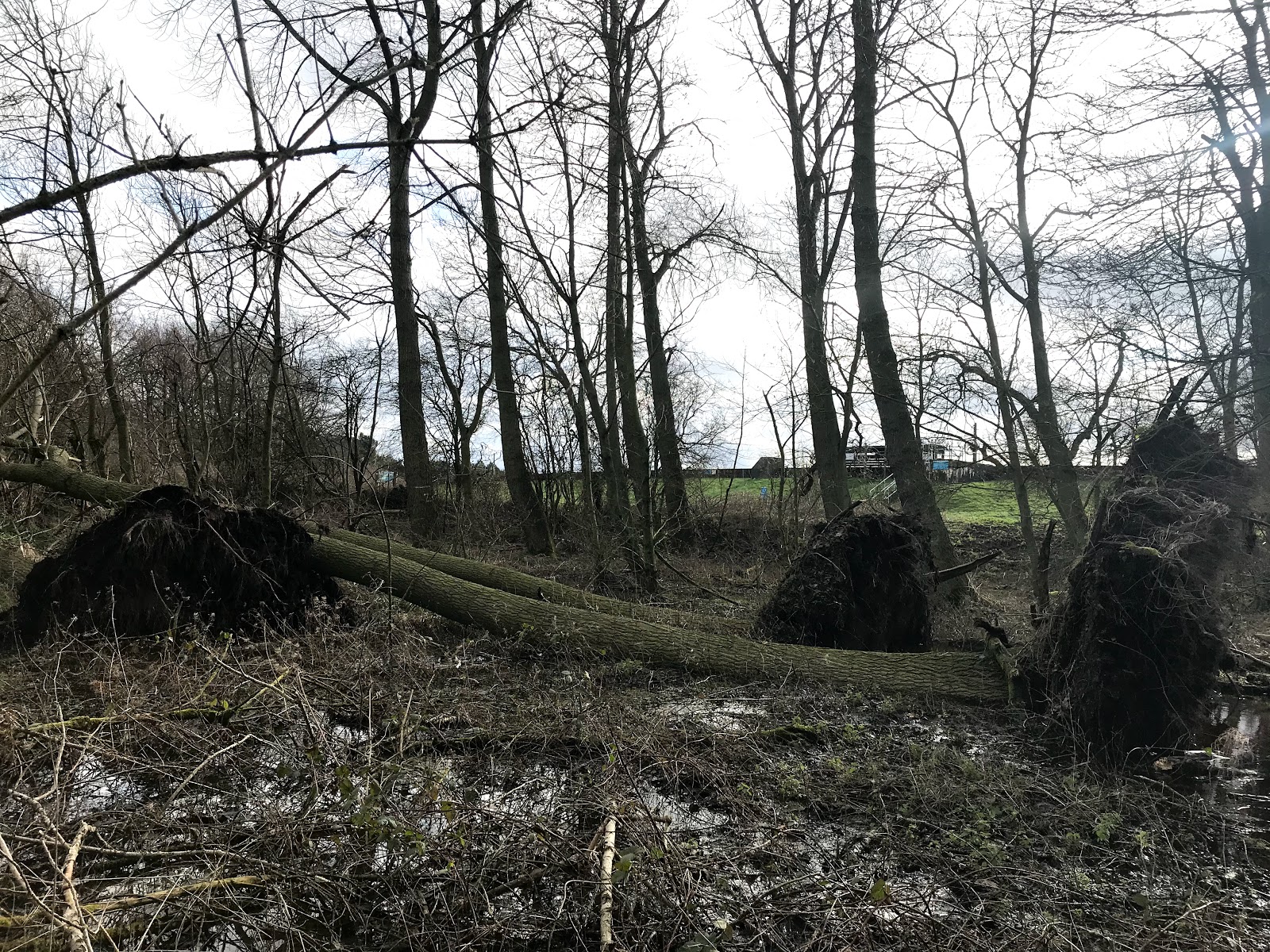
Many have asked what the damage is from the flooding - has the photo hide been submerged? etc.  the answer is nothing;  All the risk was in if it did breach - as it didn't nothing has changed on that front so apart from a lot of cobwebs its as we left it.  The same cannot be said though of Ceira and Dennis however.  The gales of February have caused a lot of devastation - perhaps most notably in O res wood - fancy a walk to O res?:
The southern site was blocked off for two weeks or so until cleared.  The big root plates we'll leave as habitat:
We've assessed some of the remaining poplars on this corner and unfortunately more will have to go as the wet ground and open canopy are going to lead to more losses.  In the interim until opening we have professional tree contractors coming to sort a number of damaged trees to make the site safe for the public:
A telling barometer of the wind is that in some areas all the elder - normally sheltered beneath the canopy has been flattened horizontally: 
Needless to say there has been a lot of debris and damage around the paths on site and the hides have gone back to nature:

As such on Wednesday the 18th of March there will be a members clean up day - start at 9:30am to help clear the paths, re-open the hides, clean the hides and ready the Holt education room ready for the first school groups of the year.  You'll need to show your existing membership card and its strictly for 'work' - not birding or photography - but an interesting chance to see the lay of the land amongst clearing paths, re-opening, cleaning and furnishing hides and helping prep the holt education room.

Friday the 20th of March in the Tophill 'bio-blitz' for existing members only (Again please bring your card and we strictly won't be doing new memberships or day tickets on the day and non-2019/20 members will be turned away).  Given we have been closed for so long and Amy and I have seldom been on site we have no knowledge of what's here.  This will be the chance to bird and photo the site and find out some of what the wildlife has been up to ready to convey to the public for the Saturday 21st public re-opening.  

We did set up some trail cameras when we did get in to resolve some strange goings on;  We wanted to try and work out odd things like this;
You'll be surprised at what ate it.  More interesting info to follow in coming days...

In the meantime new membership season is upon us.  Prices remain as last year; as ever please call in or print the form on the membership tab above.  Alas we still have no card payment option so cheque or cash please.  As last year membership also includes the new access codes to the Izzard hide (changes 1st April).

For 2019-20 members that missed out on three months membership we'll be doing a deducted price against renewals.  If you present (or enclose) your 2019/20 membership card we will be doing renewals at £22 (from the standard £28) or £16.50 concessions (from the standard £22).  Some members have very kindly offered to refuse any reimbursement for the missing months - if you make us aware we'll contribute this towards Margaret's education set up to help buy kit for the school visits and help inspire a new generation.

For day tickets please note from the 1st of April we'll be splitting the current £1.80 concession price into a separate £1.50 for 5-16 year olds and £2.50 for 65 and over.  Adults remain the same at £3.50.

Moving on further we had to unfortunately abandon the photography exhibition in December because of the flooding - this will now be running from Saturday the 4th April to Sunday the 19th of April.  Thanks for those whom supplied the images already we have in store ready to go.  For further entries we'll be accepting them from the 21st March to 5pm on Thursday the 2nd of April.  I've added the entry form on the events program with all the classes and rules.  Prizes will be either membership or a reimbursement for those who've taken one.

This caused us another issue as we'd planned to use an image from the exhibition as the new membership pass for 2020.  As such we had to find a neutral image that wouldn't be favoring an individual;  Therefore we have gone futuristic and have turned to AI for the image:  This cracking shot of a little egret was taken in South Marsh East on a trail camera last year and as such was taken by a robot:
I'm afraid its the future folks;  I have a feeling we may be reverting to trail cameras for more imagery this year.  We've already had instructions on coronavirus procedures and hand sanitisers on site for school visits;  It's not been a good year for us humans thus far but at least the wildlife is reveling in our absence - By 2021 it'll be be like Pripyat...  More posts to follow in the coming days with a wildlife news round up shortly with some of what has been going on:

Finally on the theme of bad human news we've also lost a few good hands since January;  Terry Mahoney of the nest box team and former Chairman of Beverley Naturalists;

Les Bardwell Volunteer Warden and Wetland Bird Survey Counter of many years.

And after a short illness Derrick Venus long term regular and latterly volunteer in the Reception Hide since opening; 
All will be greatly missed and the landscape very much different when we do open.  For those wishing to pay their respects Derrick's funeral will be at Octon 10:30am on the 17th of March.